Dense controls need a thermal and wiring plan
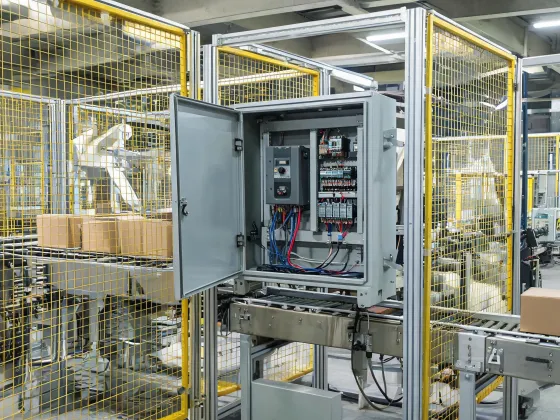
PLC racks, variable frequency drives, contactors and power supplies compete for mounting space while adding heat. A typical packaging or assembly cell review begins with component losses, duty cycle, 50/60 Hz supply, cable segregation, door-mounted operator devices and access for replacement. The layout must preserve creepage distance and clearance distance required by the selected components and applicable design standard.
Trade-off: A compact cabinet can reduce floor space and cable length, but lower free volume and obstructed airflow can increase temperature. Conservative derating and a larger enclosure may improve serviceability. The correct choice follows a documented heat balance and maintenance plan.
Availability begins with observable conditions
Critical facilities coordinate power distribution, cooling and monitoring across rooms with strict access rules. An enclosure review documents heat rejection, redundancy boundaries, airflow direction, service clearance, network topology and alarm ownership. Modbus TCP or another supported protocol may carry cooling and condition data, but protocol compatibility must be confirmed for the actual devices.
Limitation: Connected alarms show measured conditions; they do not confirm torque, seal condition or blocked airflow. Periodic physical inspection remains necessary, and network segmentation must be handled by the facility’s controls and cybersecurity teams.
Ingress language must match actual exposure
Pump controls and instrumentation may face humidity, dust, splashing, cleaning chemicals or outdoor temperature swings. Engineering teams identify the exposure first, then confirm an applicable IP rating or NEMA enclosure type, material, gasketing and cable-gland method for the selected series. Stainless construction can support corrosive environments, yet alloy choice and cleaning chemistry still require review.
Trade-off: Strong sealing limits ingress but can trap internally generated heat. Pressure equalization, cooling selection and cable-entry discipline must be evaluated together rather than optimized separately.
Distributed assets shift the maintenance equation
Remote electrical nodes require clear isolation, controlled access, environmental protection and service logistics. Centralized monitoring offers a unified operating view, while distributed control can improve local autonomy and fault isolation. Selection depends on communications availability, failure consequences, spare strategy and the personnel who can reach the site.
Verification path: Record rated voltage, rated current, prospective fault current and grounding requirements; then validate assembly SCCR, protection coordination and jurisdictional documentation with the responsible electrical engineer.